Key takeaways
- FODzyme contains three enzymes: fructan hydrolase (garlic, onion, wheat), alpha-galactosidase (beans, legumes), and lactase (dairy) — not just fructans.
- The best available human evidence is a 2026 open-label cohort study — there is no published double-blind placebo-controlled RCT yet.
- It does not help with polyols (sorbitol, mannitol) and actually increases free fructose — caution if you have fructose malabsorption.
- Denatures above 60°C / 140°F — add it just before eating, not to steaming hot food.
Garlic and onion are in almost everything. Restaurant food, stock cubes, most sauces, family dinners you can't quietly opt out of. If fructans are your trigger, you've probably resigned yourself to the choice between suffering or spending social energy explaining yourself.
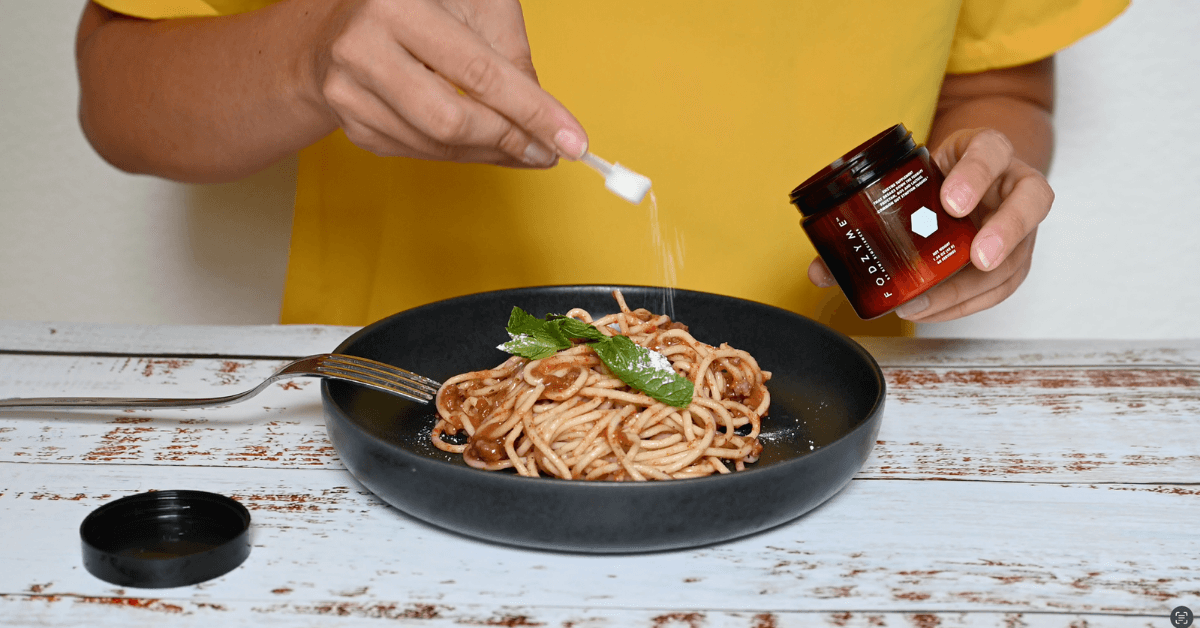
FODzyme, made by Boston-based biotech Kiwi Biosciences (Y Combinator-backed, founded 2020), takes a different approach: break the problematic molecules down before they reach your colon. Sprinkle the powder on your food at the start of the meal and the enzymes get to work in your small intestine.
It's a genuinely interesting product. But a lot of what's written about it online is either inaccurate or oversimplified. Here's what the evidence actually shows.
What's actually in it — three enzymes, not one
Most reviews describe FODzyme as a "fructan enzyme." That's underselling it. The current formulation contains three separate enzymes:
- —Fructan hydrolase — breaks down fructans found in garlic, onion, wheat, rye, leek, and asparagus
- —Alpha-galactosidase — breaks down GOS (galacto-oligosaccharides) in beans, lentils, and legumes
- —Lactase — breaks down lactose in dairy products
This makes it meaningfully broader than a single-enzyme product like Beano (alpha-galactosidase only) or standard lactase tablets. The fructan hydrolase is the novel piece — it's derived from Aspergillus tubingensis and has both endo and exo activity, meaning it cleaves fructan chains at internal points and at the ends.
One important consequence of how fructan hydrolase works: breaking down fructans releases free fructose. If fructose malabsorption is one of your triggers, that released fructose could cause problems. FODzyme is not suitable for people with fructose intolerance.
What the research actually shows
This is where a lot of reviews get it wrong. FODzyme does not yet have a published randomised, double-blind, placebo-controlled clinical trial in IBS patients. The existing evidence is:
- —2023 in vitro study (Castro Ochoa et al., Gastro Hep Advances) — tested FODZYME in a validated laboratory simulator of the human GI tract (SHIME®). Found 90% of inulin degraded within 30 minutes, with reduced gas production. This is lab evidence, not human trial evidence.
- —2026 real-world cohort study (Kaye et al., Gastro Hep Advances) — 118 participants who had purchased FODzyme completed surveys at baseline and 4 weeks. 78% reported clinically meaningful improvement in bloating and flatulence; 65% in abdominal pain. This was open-label (no placebo group), so placebo effect cannot be ruled out. Funded by Kiwi Biosciences, though independently analysed.
- —2024 safety study — randomised, placebo-controlled, showing a good safety profile with no serious adverse events.
- —Ongoing RCT (NCT06628869) — a proper double-blind crossover trial testing fructanase after a 25g inulin challenge. Results pending.
The 2026 cohort results are encouraging, and the in vitro mechanism is well-supported. But the honest summary is: we don't yet have a published gold-standard trial. The product may well work — but be appropriately sceptical of reviews that treat the current evidence as definitive.
What about "wheat sensitivity"?
Research by Biesiekierski et al. found that many people who believe they react to gluten are actually reacting to fructans in wheat — not gluten itself. FODzyme can help that group by degrading the fructans before they ferment.
It does not break down gluten protein. It will not help anyone with coeliac disease and is not a substitute for a gluten-free diet in that context. The overlap between "I react to wheat" and "I react to fructans in wheat" is significant but not total.
Before you buy
- —Denatures above 60°C / 140°F — if it's too hot to comfortably hold in your mouth, it's too hot for FODzyme. Works well with room-temperature, warm, and chilled foods.
- —Does not work on polyols (sorbitol, mannitol) — if stone fruit, mushrooms, or artificial sweeteners are triggers, FODzyme won't help with those.
- —Not for fructose malabsorption — the enzyme breaks fructans into free fructose, which may worsen symptoms if fructose is also a trigger for you.
- —Use it after your elimination and reintroduction phases, once you know what your actual triggers are — not as a shortcut through elimination.
- —The powder (jar or stick packs) works faster than capsules because it contacts food directly in the stomach. The stick packs are convenient for eating out.
- —Pricing is around £55–65 for 60 doses on subscription. At roughly £1 per meal, it's not cheap — most useful for unavoidable situations rather than every meal.
References
- 1.Castro Ochoa KF, Samant S, Liu A, et al.. Castro Ochoa et al. — In vitro efficacy of FODZYME in simulated GI environment (2023) — Gastro Hep Advances, 2023
- 2.Kaye G, Meyers A, Hachuel D, Wells A, Wallach T, Thor P, et al.. Kaye et al. — Real-world cohort study of FODMAP-targeting enzyme blend (2026) — Gastro Hep Advances, 2026
- 3.
- 4.Biesiekierski JR, Peters SL, Newnham ED, et al.. Biesiekierski et al. — Fructans, not gluten, as the cause of symptoms in non-coeliac gluten sensitivity (2018) — Gastroenterology, 2018
- 5.