Key takeaways
- MilkAid chewable tablets come in raspberry and vanilla flavours — the vanilla version contains sucralose, which can itself cause IBS symptoms in sensitive people.
- The MAX Capsules (9000 ALU) are unflavoured and additive-free — the better choice for IBS sufferers who want to avoid extra variables.
- Lactose intolerance and lactose as a FODMAP are not the same thing — not all IBS sufferers need to limit lactose.
- During the elimination phase, switch to naturally low-lactose foods (hard cheese, lactose-free milk) rather than relying on enzyme supplements.
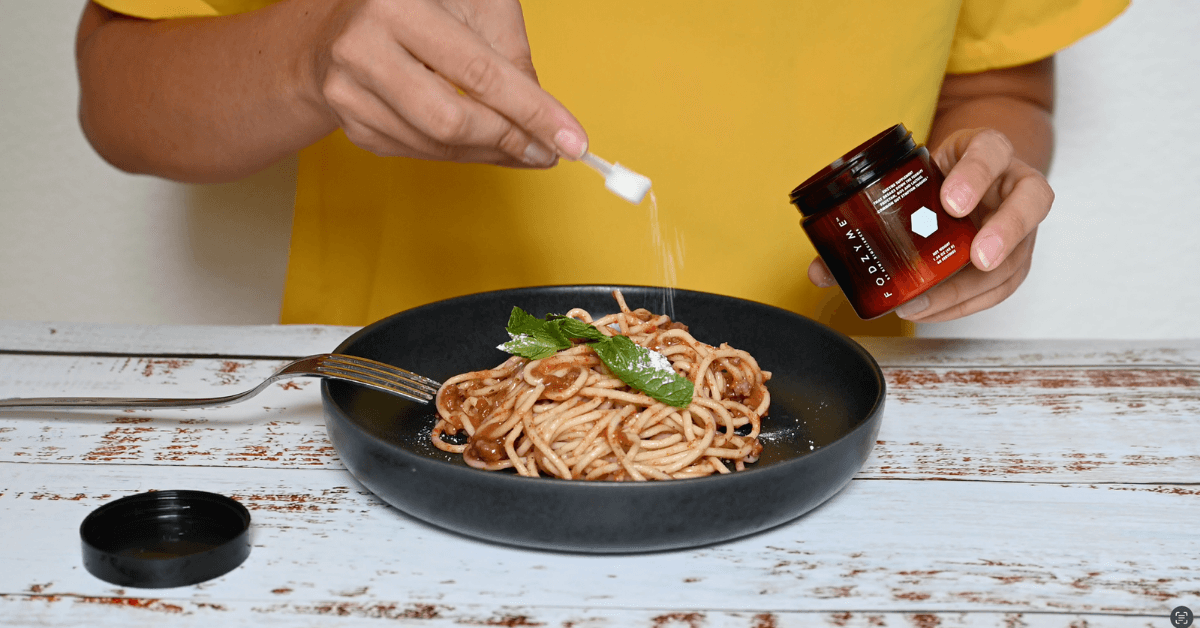
MilkAid is a lactase enzyme supplement made by Crosscare, a British-Irish company that also makes Colief infant drops. You take it before eating dairy and the enzyme breaks lactose down into glucose and galactose — sugars your body can actually absorb — before they reach your colon and ferment.
It won Pharmacy Product of the Year 2024 and is widely stocked at Boots, Tesco, and Holland & Barrett. It works. But if you have IBS, there's something worth knowing before you pick up whichever box is on the shelf.
The formats — and what's actually in them
MilkAid comes in four formats, and they're not all equal for IBS:
- —Raspberry chewable tablets — 3,000 ALU per tablet, raspberry flavouring, glucose syrup, magnesium stearate. The most widely sold version in pharmacies.
- —Vanilla chewable tablets — 3,000 ALU per tablet, vanilla flavouring, magnesium stearate, and sucralose. Sucralose is a poorly-absorbed sweetener that causes bloating and loose stools in a meaningful proportion of IBS sufferers.
- —MAX Capsules — 9,000 ALU per capsule. Unflavoured, no artificial colours, no preservatives, vegan. Three times the dose of a standard tablet in a single capsule.
- —Drops — Liquid lactase you add to milk before drinking. Unflavoured. Can reduce lactose content by up to 99% when left overnight. Useful if you're cooking or want to treat a full bottle of milk rather than dosing per meal.
Dosing and timing
Take MilkAid at the very start of your meal — with the first bite or sip of anything containing dairy. The enzyme needs to be present in your gut at the same time as the lactose, before the food moves through the small intestine.
Underdosing is the most common reason people say lactase supplements "don't work." Standard guidance is 1–2 tablets (3,000–6,000 ALU) for a moderate dairy portion, up to a maximum of 6 tablets per meal. The MAX Capsule's 9,000 ALU single dose covers most scenarios without needing to take multiple tablets. For a large portion — say, a creamy pasta plus ice cream — you may want to supplement across courses.
Lactose intolerance and IBS aren't the same thing
This is the distinction that most lactase supplement reviews miss. Lactose intolerance is a digestive condition caused by low lactase production — your gut can't break down lactose, so it ferments in the colon. IBS is a separate functional gut disorder.
They frequently overlap, but they're not identical. Monash University's position is clear: if you have IBS and are following the low-FODMAP diet, you only need to limit lactose if you are also lactose intolerant. Hard cheeses (cheddar, parmesan, brie) and butter contain negligible lactose and are fine for almost everyone on the FODMAP diet. Regular cow's milk in large amounts is high FODMAP — but that's because of lactose, and if your gut handles lactose fine, it's not a trigger for you.
If you're not sure whether lactose is a personal trigger, the only way to find out is through the formal reintroduction phase — testing regular milk in controlled amounts and noting your response.
During the elimination phase
Lactase supplements are not a clean substitute for lactose-free products during elimination. The goal of the elimination phase is a complete baseline — every variable removed. An enzyme supplement adds uncertainty: did your symptoms improve because of the diet, or because of the dose of enzyme you took? And if you underdose (which is easy to do), you've reintroduced lactose without knowing it.
The cleaner approach during elimination: use lactose-free milk and yoghurt, which are manufactured with lactase already added and are reliably low in lactose. Hard cheese and butter are naturally near-zero lactose and need no substitution at all.
References
- 1.Misselwitz B, Butter M, Verbeke K, Fox MR. Misselwitz et al. — Lactose intolerance: mechanisms, diagnosis and management (2019) — Gut, 2019
- 2.
- 3.Vesa TH, Marteau P, Korpela R. Vesa et al. — Lactose intolerance (2000) — Journal of the American College of Nutrition, 2000