Key takeaways
- A landmark 2009 BMJ trial found psyllium significantly reduced IBS symptoms vs. placebo; wheat bran made things worse.
- Psyllium is a soluble gel-forming fibre — low FODMAP at 5 g, fermenting only at very high doses.
- It helps both IBS-D and IBS-C because it normalises transit in either direction.
- Start at 1 teaspoon daily with a full glass of water and give it 4–6 weeks before judging.
Psyllium husk is one of the few IBS supplements with reasonably solid clinical evidence behind it. That doesn't mean it works for everyone — IBS is too variable for that — but the research is more credible than most things sold in the gut health aisle.
The standout study
A 2009 trial in the BMJ (Bijkerk et al.) randomised 275 IBS patients to psyllium, wheat bran, or placebo over 12 weeks. Psyllium significantly reduced symptom severity. Wheat bran performed no better than placebo and made things worse for some participants.
That last part is worth sitting with: insoluble fibre (wheat bran) — which gets pushed as broadly beneficial — actively worsened IBS in a subset of participants. Psyllium is predominantly soluble fibre, which behaves differently.
Why soluble vs insoluble matters
Insoluble fibre (wheat bran, bran cereal, raw vegetables) adds bulk and speeds transit — good for some types of constipation, bad if your gut is already irritated. It doesn't dissolve in water and passes through largely intact, which means it can physically irritate the gut lining.
Soluble fibre dissolves and forms a gel in water. Psyllium is around 70% soluble fibre. The gel slows transit slightly, softens stool, and provides a food source for beneficial gut bacteria — without the fermentation that causes gas (the kind you get with FOS, inulin and GOS).
IBS-D and IBS-C both respond
This is unusual. Most interventions help one subtype and worsen the other. Psyllium's gel-forming property regulates transit in both directions: it adds structure for watery stool in IBS-D, and provides bulk and softness to help with IBS-C. The mechanism is the same — it normalises rather than just accelerating or slowing.
Low FODMAP status
Psyllium husk powder is low FODMAP at the standard dose (5 g). It doesn't ferment significantly in the colon at normal amounts, which is why it doesn't cause the gas that other fibres do. This makes it compatible with the elimination phase — it won't muddy the symptom picture the way, say, an inulin-containing supplement would.
How to actually take it
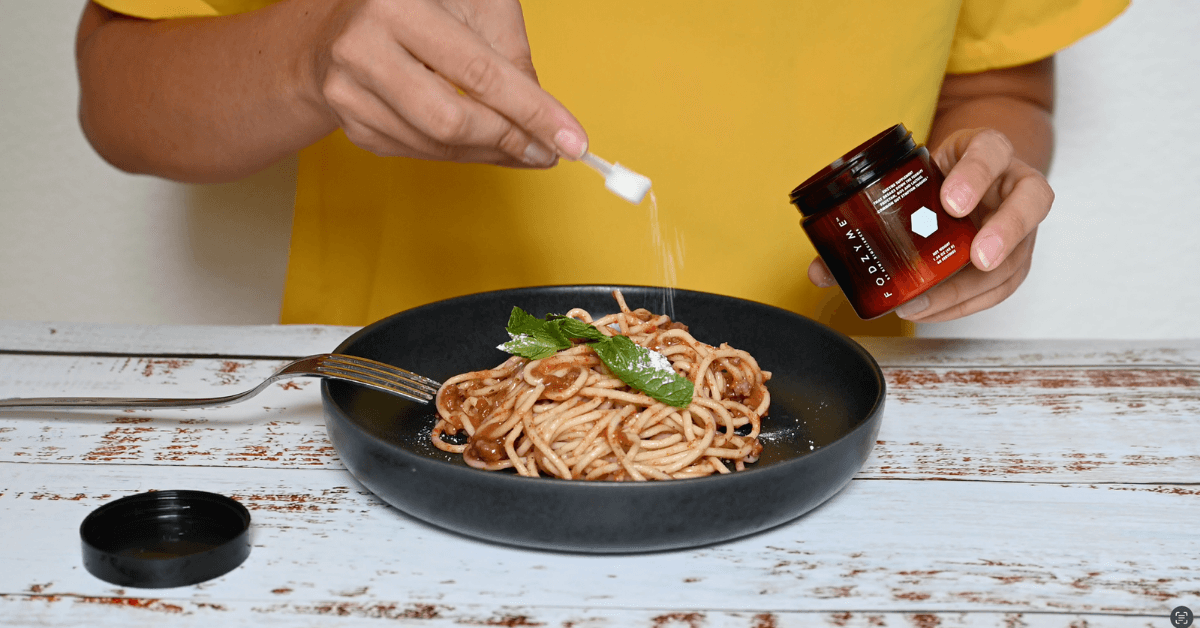
- —Start at 5 g (about 1 teaspoon) once a day — usually morning works well
- —Mix with a full glass of water (at least 250 ml) — it needs liquid to form the gel. Without it, it can cause a blockage
- —Give it 4–6 weeks before deciding whether it's helping. Short trials miss the cumulative effect
- —Powder dissolves more completely than husks and tends to be gentler. Both are low FODMAP
- —If you're on medication, take psyllium at least an hour apart — it can reduce absorption of some drugs
What it won't do
Psyllium isn't a trigger treatment. It won't stop a flare caused by eating something high-FODMAP. Think of it as background infrastructure — something that keeps the gut more stable day-to-day, rather than a rescue tool.
It also won't work for everyone. A significant proportion of IBS patients in the Bijkerk trial didn't respond. If you've been taking it correctly for 6 weeks and nothing's changed, it probably isn't your thing.
References
- 1.Bijkerk CJ, de Wit NJ, Muris JWM, et al.. Bijkerk et al. — Soluble or insoluble fibre in IBS: randomised placebo controlled trial — BMJ, 2009
- 2.Moayyedi et al. — Effect of fibre supplementation on IBS (meta-analysis) — American Journal of Gastroenterology, 2014
- 3.